

EVE MUSE · AI Skin Analysis
Your skin, finally explained.
Before we recommend a single treatment, we look properly. Eve Muse photographs your face under five specialized light sources — reading pigment, wrinkles, pores, redness, breakouts, dark circles, hydration and facial contour in a single scan — then we review every layer with you, on screen.
About 15 minutes · nothing touches your skin · results reviewed the same visit
Skin analysis
Aesthetic & contour analysis
Tap a dimension to explore
Demo scan imagery courtesy of EveLab Insight — shown on a demo model, not a Balance Lab client. Your Eve Muse report will be unique to you.
What we see
Over forty concerns, in one sitting.
Eve Muse captures your face under five specialized light sources — white, UV, cross-polarized, parallel-polarized and Wood's light — reading over forty surface and subsurface concerns, your skin type, and an overall skin-age grade compared to peers your age. Here's what that covers.
Dark spots & pigment
UV light reaches pigment that hasn't surfaced yet — sun damage, melasma, freckles and age spots. Seeing where it's clustered, and how deep, tells us whether to treat gently or go further.
Wrinkles & fine lines
Depth-mapped across the forehead, glabella, crow's feet, nasolabial folds and marionette lines — plus eyelid laxity, eye bags and tear troughs. This separates a line that needs relaxing from one that needs resurfacing or volume.
Pores & texture
Parallel-polarized light highlights surface detail — pore size, roughness and tone evenness. It's the difference between a facial that helps for a week and a routine that changes your skin.
Redness & sensitivity
Cross-polarized light cuts surface reflection to reveal visible vessels and inflammation you may not notice in the mirror. When this is elevated, we slow a protocol down rather than push it.
Breakouts & congestion
Blackheads, comedones, papules and acne marks — counted and located, including the porphyrins under UV light that signal where congestion is building.
Dark circles
Not all dark circles are the same. The analysis distinguishes pigmented, shadowed and vascular types — and the right treatment is different for each.
Moisture, oil & skin type
Your oil-water balance and one of sixteen skin type profiles — dry or oily, sensitive or resistant, pigmented or even, loose or firm. This is what your at-home routine gets built around.
Contour, angles & symmetry
3D structural analysis: facial thirds, contour lines, cheek volume, lifting angles and side-profile angles. This is how we plan balanced, natural-looking results — and how we prove them later.
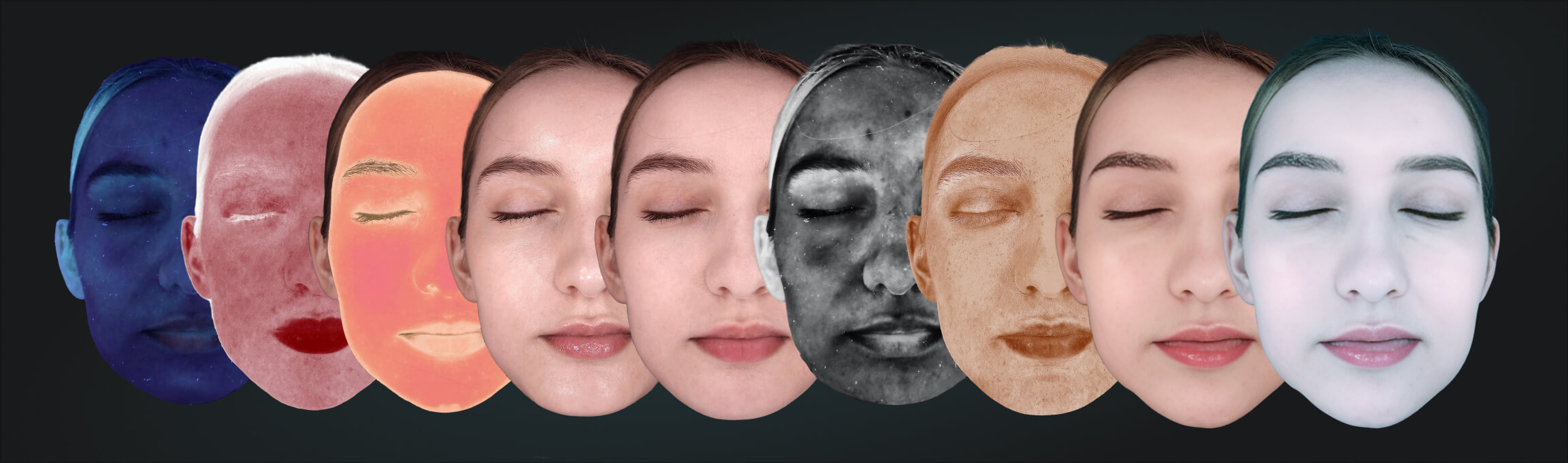
One face, nine ways of seeing it — the same scan captured under white light, UV, cross-polarized, parallel-polarized and Wood's light channels.
Your visit
Fifteen minutes that change the conversation.
Nothing touches your skin, nothing stings, and there's no recovery. Come as you are — though a clean face gives us the clearest read.
Sit and scan
You rest your face in the device for a few moments while it captures. That's the whole procedure — no needles, no heat, no discomfort.
See your layers
Your results appear on screen within moments — pigment, wrinkles, texture, redness, breakouts, dark circles, hydration and contour, plus your skin type and overall skin-age grade.
Talk it through
Your provider walks you through what each layer means for your skin — and just as importantly, what you don't need.
Come back and compare
We re-scan at your follow-ups. Progress stops being a feeling and becomes something you can see side by side.
Your plan
From what we find, to what we do.
Every finding connects to something we actually offer. Select what concerns you most and see where the analysis usually leads — your provider will tailor it to you.
If pigment is the story
If lines and laxity lead
If texture needs work
If redness is elevated
If breakouts are active
If hydration and glow are low
If volume has shifted
If it's coming from within
Why we invested in it
"Balance begins with understanding. When you can see your own skin clearly, the plan stops being a sales pitch and starts being a decision you make with us."
— Annie Kim, MSN, FNP-C · Founder
Balance Lab was built around Korean beauty philosophy: treat the skin gently, treat it consistently, and treat the whole person rather than a single complaint. Analysis fits that approach exactly — it keeps us from over-treating skin that needs rest, and it catches what quietly needs attention.
It also keeps us honest. When your provider recommends something, you'll have seen the reason for yourself.
Questions
Before you book.
Does it cost anything?
No. The EVE MUSE skin analysis is complimentary with your consultation at Balance Lab, and there is no obligation to book a treatment afterward.
Does it hurt?
Not at all. Nothing touches your skin. You simply position your face in the device while it captures a series of images.
How long does it take?
The scan itself takes only a few minutes. Plan for about fifteen minutes including the review of your images and results with your provider.
Should I wear makeup?
Please arrive with a clean face when possible. Makeup, sunscreen and heavier skincare products can affect what the camera is able to capture. We can cleanse your skin before the scan when needed.
Is this a medical diagnosis?
No. EVE MUSE is an imaging and consultation tool used to support aesthetic planning and progress tracking. It does not diagnose skin disease or replace medical evaluation.
How often should I be scanned?
Most clients re-scan at treatment milestones or approximately every three months, depending on their plan. Your provider will recommend a timeline that makes sense for your skin.
Can I compare my results later?
Yes. Your images can be kept on file and reviewed side by side at future visits to help document visible changes over time.
Book
See your skin the way we see it.
Consultations are complimentary and include your AI skin analysis. Come in curious — leave with a plan built for your face.
Eve Muse is an imaging and consultation tool, not a medical diagnosis. Findings must be interpreted by your provider, and individual treatment results vary. Analysis imagery courtesy of EveLab Insight, shown on a demo model.