Journal · Under-Eyes · La Habra
Your Under-Eyes Are Not One Problem
Dark circles, hollows, bags, and loose skin are four different problems living in the same square inch — and sometimes a fifth one that isn’t in your face at all. Treating them as one is the reason so many under-eyes still look tired after treatment.
Almost every week, someone sits in my chair, pulls the skin under their eye taut with one finger, and says some version of the same sentence:
“I just look tired all the time. Can you fill this?”
I understand the request. I’ve said it to my own reflection at 6 a.m. But I’m going to tell you what I tell them, which is not what most people expect to hear from an injector:
Maybe. And maybe filling it is the thing that will make it look worse.
I’m not saying that to be difficult. I’m saying it because the under-eye is the one area of the face where I’ve seen more money spent on the wrong solution than anywhere else — and the wrong solution here doesn’t just fail quietly. It puffs. It goes bluish in daylight. It sits there for years.
So before you book anything, with me or anyone else, I want to teach you how to figure out which under-eye you actually have. It takes about ninety seconds and a mirror.
First, do this. Right now.
Go find a mirror. Real light, not phone light.
Put a clean fingertip on the darkness under your eye and gently press the groove flat — just enough to fill in the dip, not enough to tug the skin.
Now look.
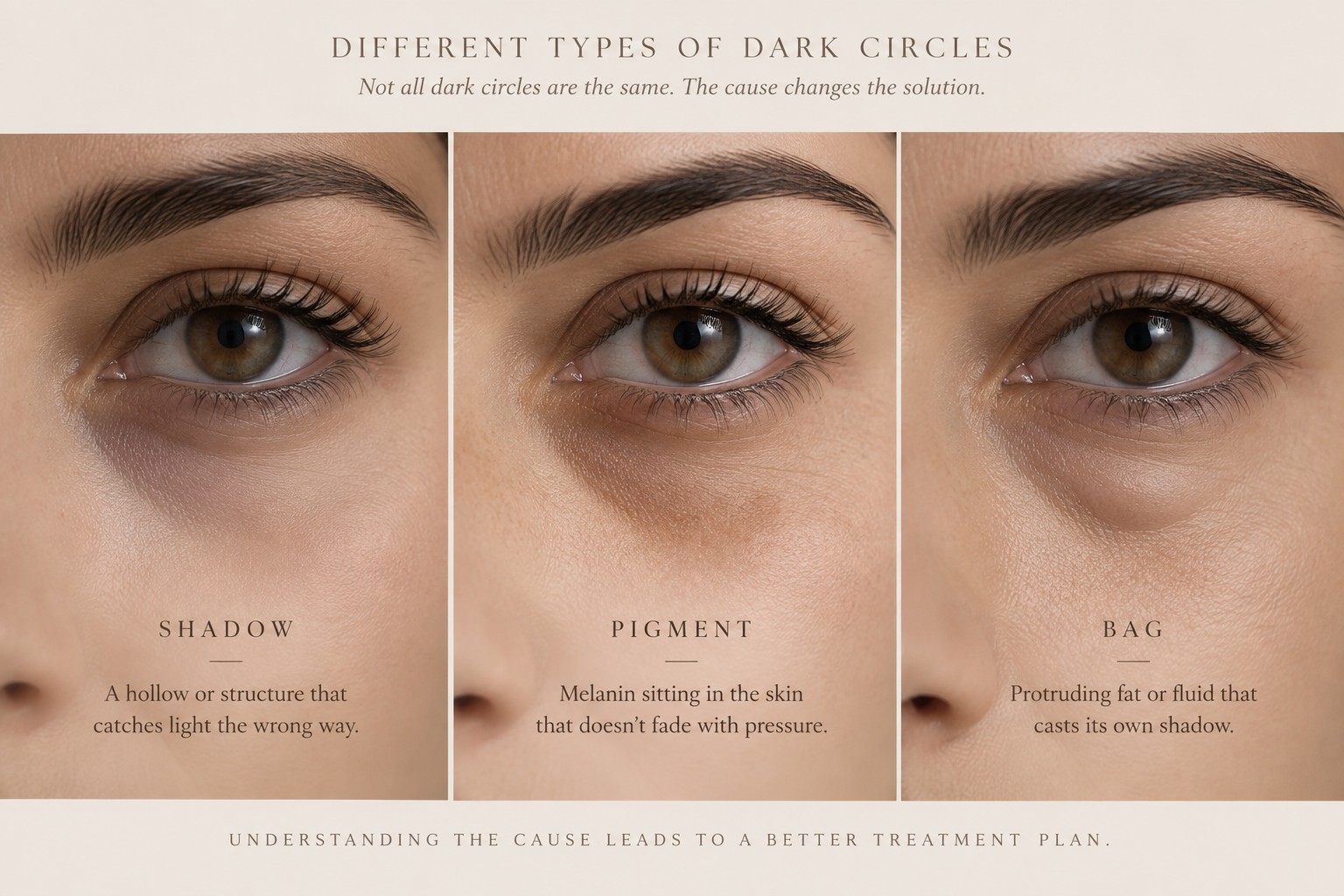
- The darkness mostly disappears? You don’t have a stain. You have a shadow. Something structural is catching light the wrong way, and no cream on earth is going to fix a shadow.
- The darkness stays right where it was? That’s pigment, or vessels showing through thin skin, or both. This one matters enormously, because filler will not lighten it — and in thin skin, filler can make it look grayer.
- You pressed and felt a bulge instead of a dip? That’s a different conversation entirely, and I’d rather you know that now than three syringes from now.
That one test separates about 80% of the confusion in this area. Keep your answer in mind — I’ll tell you what to do with it in a minute.
Why one area causes four problems
I trained in emergency medicine before I ever picked up a syringe, and that background shaped how I think about faces: figure out what’s actually happening in the tissue, then choose the tool. Never the other way around.
The other half of how I practice is functional medicine. At Balance Lab I run labs, I look at thyroid panels and iron studies and inflammatory markers, and I treat hormones — which means when a patient sits down and tells me she looks exhausted, I’m not only looking at her orbital rim. I’m also wondering what her body has been doing for the last two years to produce that face. Sometimes the answer is anatomy. Sometimes it’s biology. Usually it’s both, in a ratio I can’t guess from across the room.
That’s the whole premise of this practice: biology first, always. A syringe can change a shadow. It cannot change why the tissue got thin.
Under the eye, two things are happening at the same time, and they pull in opposite directions.
You’re losing. Support along the orbital rim thins out. The midface — your cheek — quietly drops. A groove appears where there used to be a smooth transition, and a shadow settles into it.
You’re also gaining. Fat pads that used to sit politely behind a firm septum start to show. Skin gets loose. Pigment that’s been collecting since your twenties finally has thin enough skin to show through.
Treat only the loss and you’ve ignored half the face. Treat only the gain and you’ve ignored the other half. This is why “just fill it” so often produces a person who looks treated rather than rested.
The four under-eyes people mistake for one
| What you see | What it usually is | What won’t fix it |
|---|---|---|
| A groove or dip | Volume loss / tear trough hollow | Eye cream alone |
| Brown or blue-gray discoloration | Pigment, vessels, or thin skin over muscle | More filler |
| A bulge, worse in the morning | Fat pad — a true bag | Filling around it |
| Crepe, folds, extra skin when you smile | Skin quality and laxity | A heavy syringe |
Find yourself on that table. Then read the section that belongs to you — and read section 05 regardless, because it applies to almost everyone.
01 — If your darkness is a shadow
This is the most common one, and the most misunderstood.
You’ve probably spent real money on eye creams. Some of them were good products. Here’s why they didn’t work: a retinoid and consistent SPF can genuinely improve the surface — brightness, barrier, a little thickness over time. What they cannot do is rebuild a trough. You’re asking a serum to change the shape of your skull’s relationship to your cheek.
What I actually do here: I look one floor down first. When the midface drops, the lid-cheek junction gets longer, and a hollow appears that’s really a support problem in the cheek. I’ve treated plenty of under-eyes by never touching the under-eye.
If the trough itself needs addressing, I start with the quietest option that will work — usually PRF Biofill, which is your own blood, spun down and placed as a soft regenerative gel. Or Juvelook, which brings hydration now and collagen later. Both build the area up gradually rather than dropping a pillow into a delicate space.
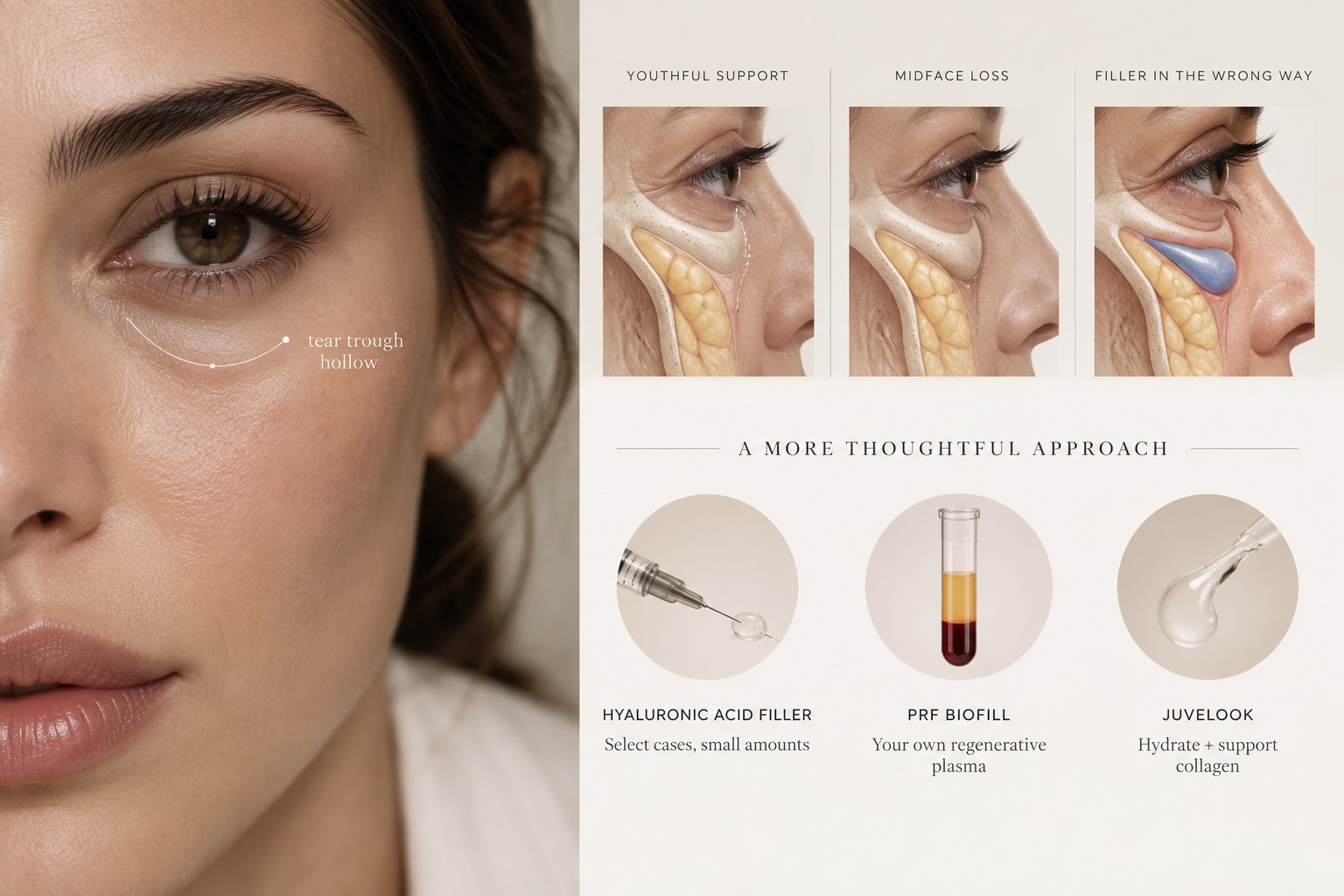
Your takeaway: Ask any provider whether the plan is filling the trough or supporting the face that created it. A quarter of a syringe placed correctly beats a full syringe placed because that’s what was on the menu.
02 — If your darkness is a stain
The finger test didn’t change anything. The color stayed.
I want to be straight with you: this is the one where I most often have to slow someone down. Filler will not fix pigment. In thin, stained skin, filler can add a bluish cast on top of what’s already there — and now you have two problems.
What I actually do here: treat it as a skin problem, because it is one. Pigment work, barrier repair, sun protection you’ll actually wear, and tissue-quality treatments that thicken the skin so the muscle and vessels underneath stop showing through. This is a series, not a single visit, and I’d rather tell you that upfront than sell you a syringe today and lose your trust in six weeks.
03 — If it’s a bag
Press on it and you don’t feel a dip — you feel a mound. It’s worse after salty food, after a short night, after a flight.
That’s orbital fat showing through a weakening septum. And here is where I’m going to say the least profitable thing in this entire article:
I cannot inject that away, and neither can anyone else.
Filler placed around a bag to “blend” it can look clever in the chair and swollen by week two. You’ve added volume next to volume. The shelf is still there — it’s just sitting on a thicker cheek now.
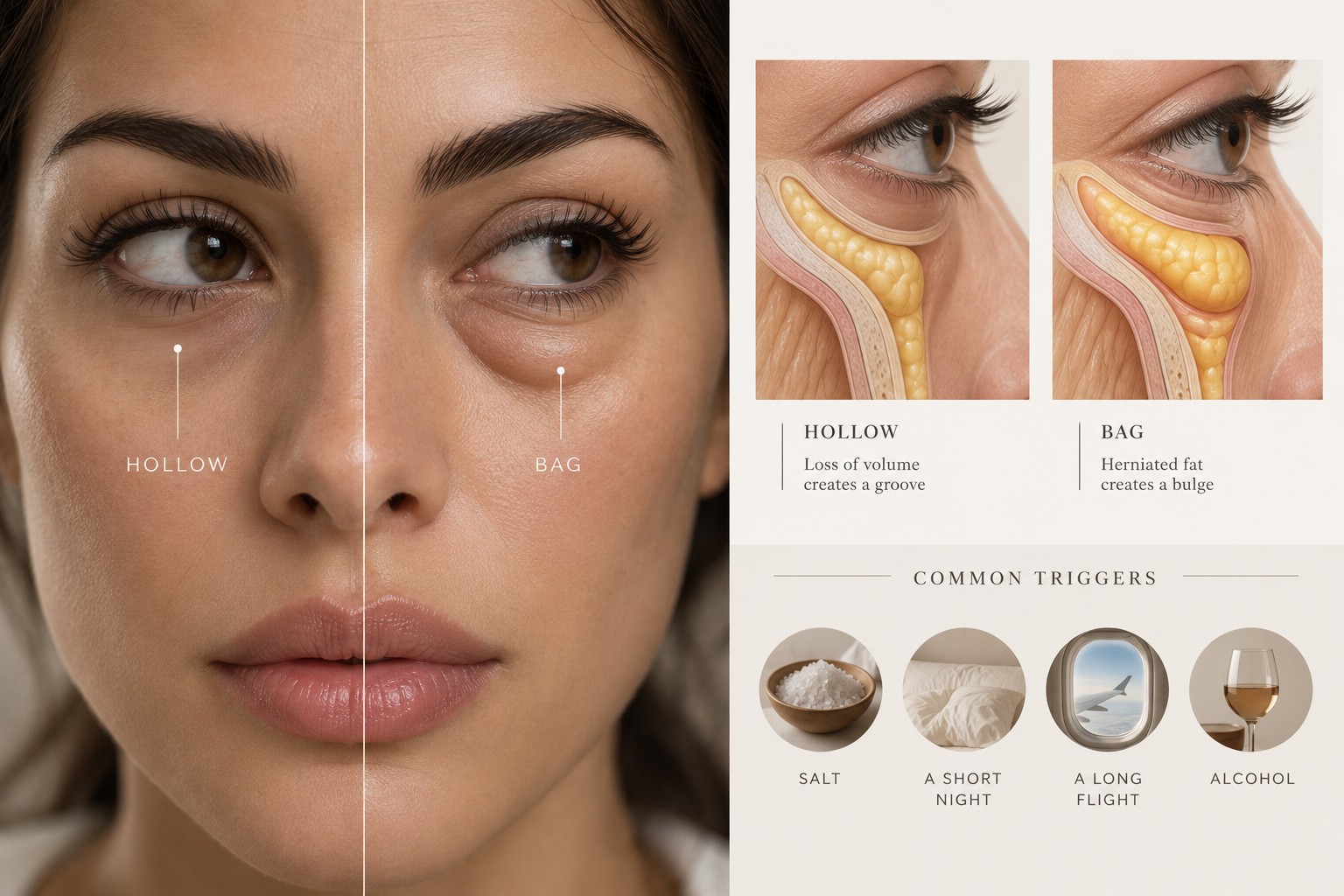
Significant fat herniation is a surgical conversation, and when that’s the honest answer, I’ll say so and point you toward someone excellent. Mild contour irregularity can sometimes be softened with skin-quality work and conservative support above or below the pad — but a bag that reads from across a dinner table is not going to be negotiated away with a needle.
I’d rather lose a treatment than have you spend $900 on camouflage.
04 — If it’s the skin itself
Crepey texture. Fine etching. A fold that shows up when you smile.
Fill this and you stretch already-thin tissue over a mound. The line doesn’t leave. Now it just sits on a pillow.
What I actually do here: treat the skin as skin. PRF to improve the tissue itself. Juvelook for hydration plus collagen. Measured laser or RF when the brief is texture and a bit of tightening — not a new eyelid. Large amounts of redundant skin, again, is a surgical sentence, and small laxity is a series rather than a miracle morning.
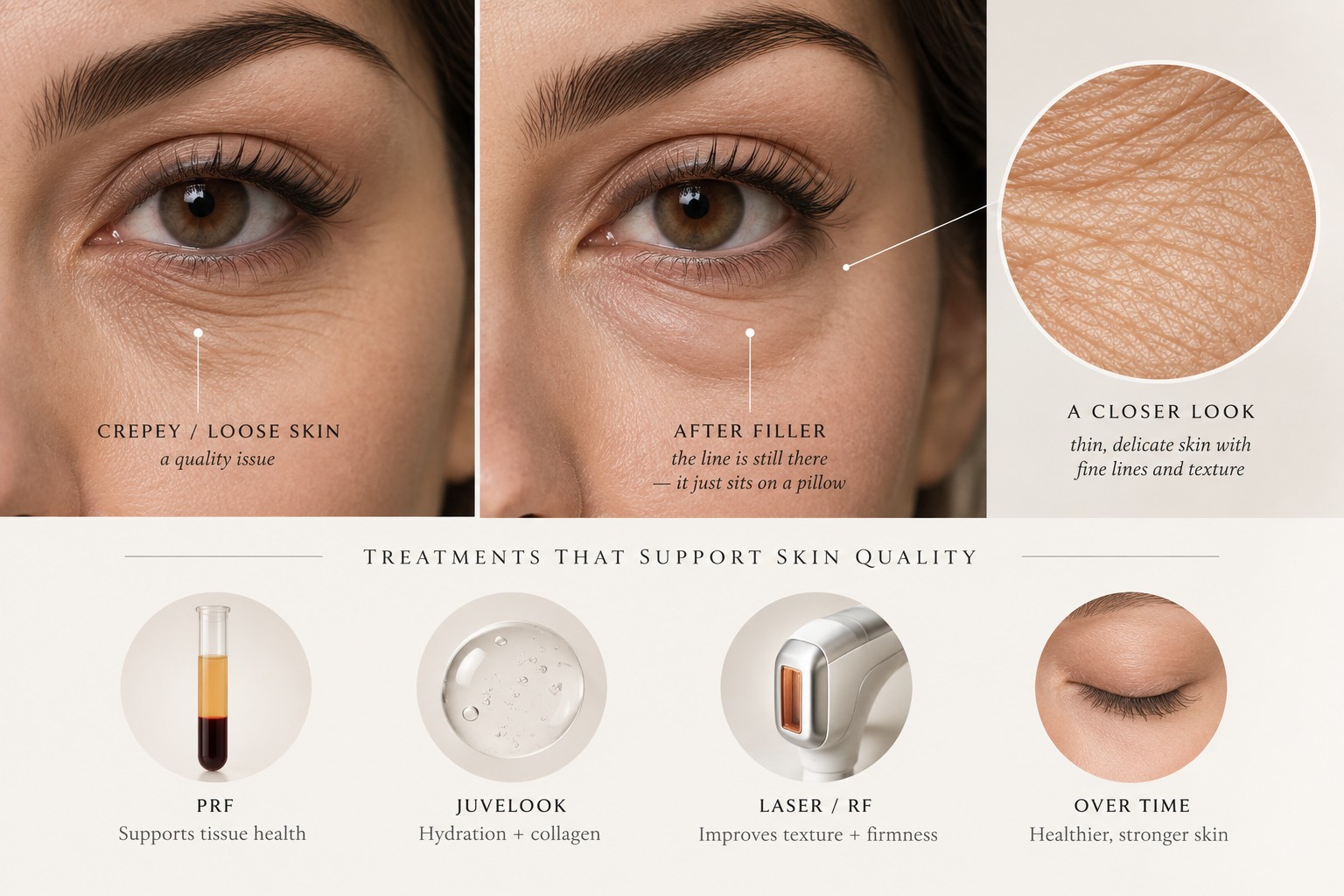
Here’s a useful clue: if your under-eye looks better the week after a hydrating, collagen-minded session and worse after filler, believe that. Your face just gave you a diagnosis.
05 — And sometimes the problem isn’t in your face at all
This is the section most aesthetics blogs leave out, and it’s the one I care about most.
The skin under your eye is the thinnest on your body. There’s almost nothing between the outside world and your blood vessels — which makes that half-inch of skin the most honest window into your physiology that you own. Things you’d never notice anywhere else show up there first.
I want to be precise here, because there’s a lot of nonsense written about this. True structural hollowing is mostly volume loss, bone change, and genetics — no green juice is reversing that. But how dark, puffy, and tired that hollow reads day to day? That part is deeply influenced by what’s happening internally. And in my experience, that’s where a meaningful amount of the complaint actually lives.
Here’s what I look for.
Sleep. Not vanity — physiology. Poor sleep dilates the vessels under thin skin and shifts fluid into the lower lid. You wake up paler, more congested, and every millimeter of existing hollow reads twice as dark. This is why some people look fine on Saturday and haunted on Tuesday with the exact same anatomy.
Iron and ferritin. I check this on nearly every fatigued woman who walks in. Low iron stores mean paler skin and less oxygenated hemoglobin, and pale skin over a purple vascular bed is a dark circle. I’ve watched circles genuinely soften over a few months of correcting iron — without touching the area.
Thyroid. An underactive thyroid can cause real periorbital puffiness and a distinct kind of dull, dry, thinner skin. If your under-eye complaint travels with fatigue, cold hands, hair thinning, constipation, or unexplained weight change, that’s not a filler conversation — that’s a lab panel. Thyroid eye conditions look different again, and need an ophthalmologist. I’d rather catch this than fill over it.
Chronic inflammation and allergies. Allergic congestion backs up venous drainage under the eye — clinicians literally call the result “allergic shiners.” Then people rub, and rubbing chronically thin skin deposits pigment that outlasts the allergy season by years. If you rub your eyes daily, that habit is part of your treatment plan.
Diet, sodium, and alcohol. Not a moral issue, a fluid issue. High-sodium food and alcohol shift water into the lower lid overnight, which is why a bag that’s dramatic at 7 a.m. can be half gone by noon. If your under-eye changes that much within a single day, fluid is a bigger character in your story than fat is.
Cortisol and long-term stress. Sustained stress affects sleep, collagen turnover, and skin barrier function. I’m not going to promise you that fixing your cortisol will erase a trough. I will say I have never once seen someone’s face look its best in the middle of a two-year stress load.
Rapid or significant weight loss. This one has become very common. When you lose weight quickly — including on GLP-1 medications — you lose facial fat along with everything else, and the midface is often the first place it shows. That’s a real, structural cause of new hollowing in someone who didn’t have it a year ago.
Genetics. Some of this you inherited, full stop. Hereditary periorbital pigmentation is extremely common, particularly in Asian and Mediterranean skin, and it’s often visible in childhood photographs. That doesn’t mean it can’t be improved. It does mean the goal is better, not gone — and any provider promising otherwise is selling.
What I actually do with this: when the picture points that direction, we run labs before we plan injectables. Sometimes that changes the treatment order entirely — we correct the internal driver first, then reassess the face in three months and discover we need much less than we thought. That’s not me stalling. That’s me not charging you to inject around a problem your bloodwork could have answered.
What actually happens when you come see me

I look at you at rest, then smiling, then with your brow raised. I’ll use overhead light and I’ll ask you about the specific bathroom lighting that made you book the appointment, because that lighting is part of the exam. It’s telling me something about angle and shadow that a flat treatment-room light will hide.
Then I ask six questions:
- Does the darkness flatten when I press the groove, or does it stay?
- Is your midface still supporting the lid, or has the cheek dropped out from under it?
- Is there a bulge that filler would only frame?
- Is the skin itself the tired part — thin, creased, pigmented — separate from contour?
- How much does this change between morning and evening, and between a good week and a bad one?
- Have you had under-eye filler before, and is any of it still sitting there?
That last question matters more than almost anyone expects. Old filler in this area can hold water for years and masquerade as a brand-new bag. More than once, my most useful first step has been dissolving something that shouldn’t still be there — and watching a patient’s “bag” disappear before I’ve built anything at all.
Please tell me if you’ve been filled here. I’m not going to judge you. I just don’t want to stack new product on top of an old map.
How to read a before-and-after (yours or anyone’s)
A good under-eye result doesn’t announce the product.
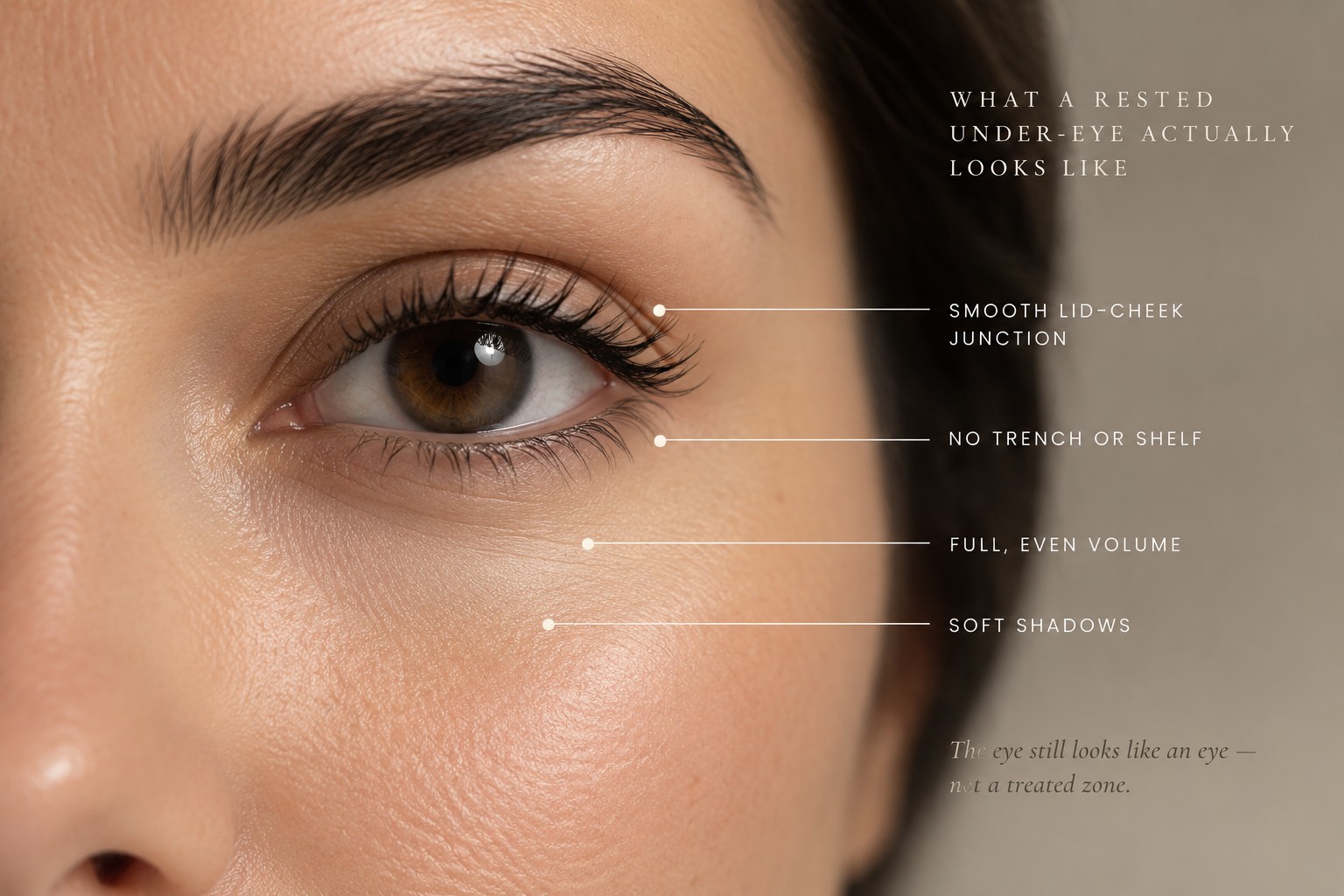
The lid-cheek transition is quieter. The eye shape hasn’t changed. Lighting matches between the two photos. And the smile still creates a few lines — because a smile with zero movement under the eye reads as edited, not rested.
A poor result is puffy in the morning, bluish in daylight, or looks oddly separate from the cheek, like a crescent that was added on. If the “after” looks like a different eyelid, the plan treated the photo instead of the face.
How we work at Balance Lab
We’re a medical aesthetics practice in La Habra, serving North Orange County — Brea, Fullerton, Yorba Linda, Buena Park, La Mirada, and Whittier. Four things guide every under-eye visit:
- Diagnose before the tray comes out. Hollow, pigment, bag, and skin are four consults that happen to share a square inch.
- Look inside when the face is telling on the body. We’re a functional medicine practice as well as an aesthetics one, which means labs, thyroid, iron, inflammation, and hormones are on the table — not as an upsell, but because sometimes they’re the actual answer.
- Regenerative first when the tissue is thin. PRF and collagen-minded injectables before conventional filler, especially if you’ve been treated here before.
- We’ll send you to a surgeon when that’s the honest answer. Camouflage is not a treatment plan.
The under-eye is where our “not done” philosophy matters most, because this anatomy has nowhere to hide a heavy hand.
Book a consultation
Come in tired of the same circle. Leave with a plan that matches the one you actually have.
Balance Lab Aesthetics
1580 S Harbor Blvd, La Habra, CA 90631
Questions I get asked constantly
Can an eye cream fix my dark circles?
It can make the skin healthier, and for pigment it genuinely helps. It cannot rebuild a hollow or remove a fat pad. If your darkness is a shadow from contour, skincare will always underperform — and you’ll blame yourself instead of the plan.
Is under-eye filler a bad idea?
It’s a specific idea. Right candidate, tiny volume, honest follow-up. Wrong candidate — thin stained skin, a true bag, leftover product from years ago — and it becomes the exact problem you came in to solve.
Why do you talk about PRF so much for this area?
Because the under-eye is often a tissue-quality problem wearing a volume costume. PRF is you, spun and placed, with far less risk of that overfilled, bluish look. It works more slowly than a syringe of HA. That’s a feature, not a compromise.
Will treating my cheeks help my under-eyes?
Sometimes more than treating the trough itself. When the midface drops, the lid-cheek junction lengthens and a hollow appears that’s really a support problem one floor down.
What if I already have filler under my eyes?
Tell me. I’d much rather dissolve something that’s distorting the area than build on top of an old map.
Can my labs really be affecting my under-eyes?
Yes — more often than most people expect. Low iron stores, an underactive thyroid, chronic allergic inflammation, and poor sleep all change how dark and puffy that area reads, sometimes dramatically. They won’t rebuild lost volume, but they can be a large share of the complaint. This is exactly why I practice both functional medicine and aesthetics.
Would you really tell me to fix my sleep instead of treating me?
Sometimes, yes — or more often, both at once. If your under-eye looks noticeably different between a rested week and an exhausted one, that variability is information, and I’d rather work with it than inject through it.
Do you see patients from outside La Habra?
Yes — most of our patients come from across North Orange County.
About the author

Annie Kim, MSN, FNP-C is the founder of Balance Lab Aesthetics in La Habra, California, and a board-certified nurse practitioner.
Annie built her clinical foundation in emergency medicine before founding Balance Lab in 2018, after earning her Master of Science in Nursing from Azusa Pacific University. Her work sits at the intersection of injectables, regenerative aesthetics, and functional medicine — the belief that the face is easier to treat when you understand what the tissue is actually asking for.
Book a consultation with Annie →
This article is for general education and is not medical advice. Under-eye treatments carry risks and are not appropriate for everyone. Individual results vary. Please consult a qualified provider about your specific situation.